Socrates on Love
Wisdom of Diotima, and the Ladder of Love.

In Plato’s Symposium, Socrates recounts the teachings of Diotima, who describes love not as a static emotion, but as a developmental process.
This progression, often called the “Ladder of Love,” frames eros as a force that can elevate human consciousness from physical attraction toward wisdom and transcendence.
The ladder unfolds in six stages.
1. Love of One Beautiful Body
The journey begins with attraction to a single person. Beauty is experienced concretely and personally through desire, admiration, and emotional intensity.
2. Love of All Beautiful Bodies
The lover realizes that beauty is not confined to one individual. Attraction becomes less possessive and more universal, recognizing beauty as a shared quality.
3. Love of Beautiful Souls
Attention shifts inward. Character, virtue, intelligence, and moral depth become more important than physical appearance.
4. Love of Beautiful Institutions
The ascent expands beyond individuals into society itself. Beauty is perceived in justice, education, ethical systems, and harmonious social order.
5. Love of Knowledge and Wisdom
At this stage, the pursuit of truth becomes central. Philosophy, science, and intellectual discovery become expressions of love directed toward understanding reality.
6. Beauty Itself
At the summit lies contemplation of Beauty in its pure form: eternal, unchanging, and beyond any particular object or person. Individual beautiful things are understood as reflections of this deeper reality.
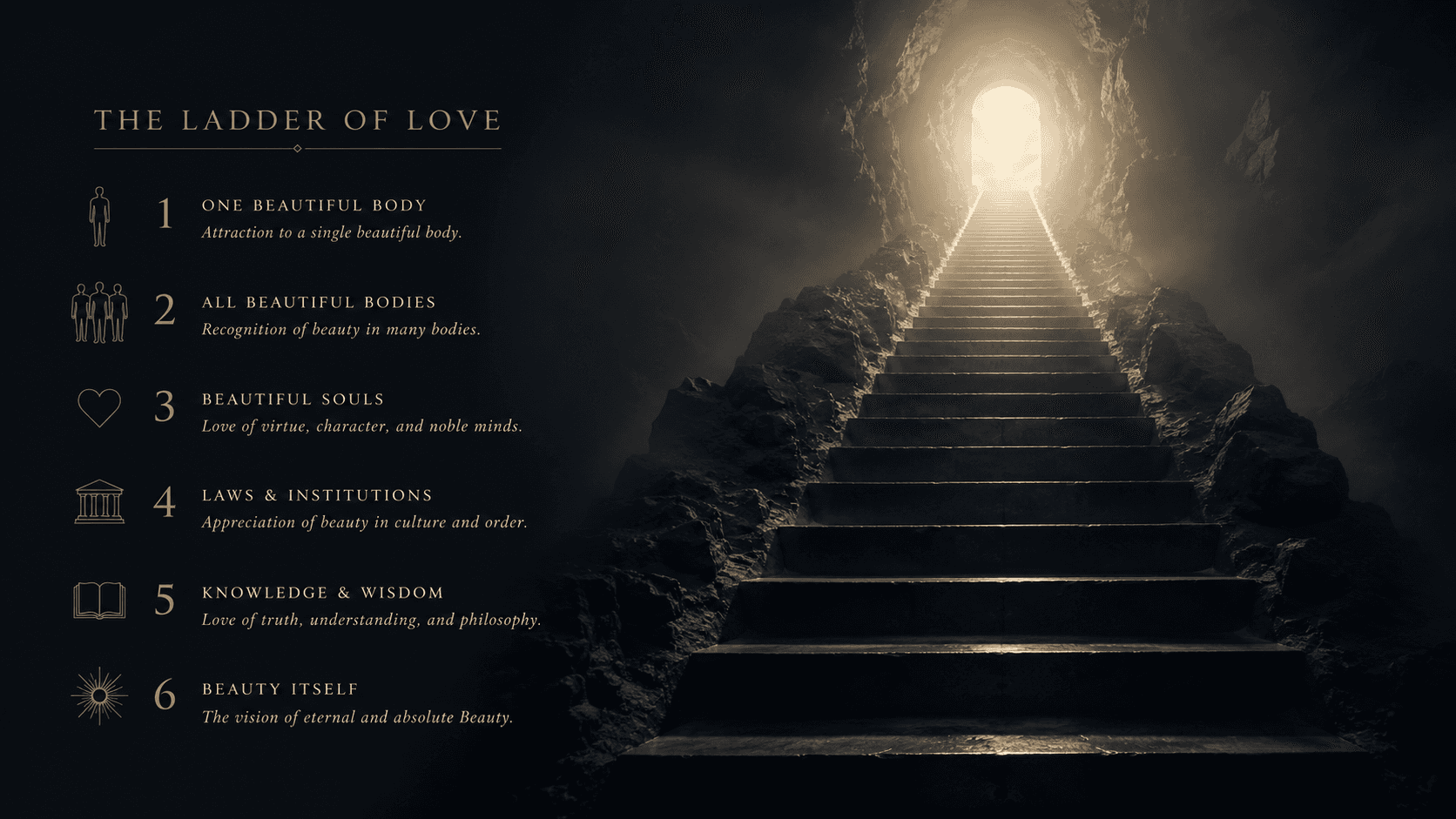
The Ladder of Love remains influential because it re-frames love as transformative rather than merely romantic.
It suggests that desire can mature into wisdom, and that human attraction may ultimately point toward deeper forms of coherence, meaning, and unity. This idea also resonates with contemporary philosophical frameworks that interpret love as an organizing force.
In the Theory of Love, Love is understood as a force that pulls conscious systems toward coherence, integration, and higher-order unity. From that perspective, Socrates’ ladder can be interpreted as a progressive expansion of coherence:
From attachment to a single body
To recognition of shared beauty
To alignment with virtue, truth, and universal forms
The ascent is not merely romantic or aesthetic. It is structural. Consciousness becomes increasingly integrated as the object of love widens from the particular toward the universal.
Wisdom of Diotima, and the Ladder of Love.
Socrates on Love
In Plato’s Symposium, Socrates recounts the teachings of Diotima, who describes love not as a static emotion, but as a developmental process.
This progression, often called the “Ladder of Love,” frames eros as a force that can elevate human consciousness from physical attraction toward wisdom and transcendence.
The ladder unfolds in six stages.
1. Love of One Beautiful Body
The journey begins with attraction to a single person. Beauty is experienced concretely and personally through desire, admiration, and emotional intensity.
2. Love of All Beautiful Bodies
The lover realizes that beauty is not confined to one individual. Attraction becomes less possessive and more universal, recognizing beauty as a shared quality.
3. Love of Beautiful Souls
Attention shifts inward. Character, virtue, intelligence, and moral depth become more important than physical appearance.
4. Love of Beautiful Institutions
The ascent expands beyond individuals into society itself. Beauty is perceived in justice, education, ethical systems, and harmonious social order.
5. Love of Knowledge and Wisdom
At this stage, the pursuit of truth becomes central. Philosophy, science, and intellectual discovery become expressions of love directed toward understanding reality.
6. Beauty Itself
At the summit lies contemplation of Beauty in its pure form: eternal, unchanging, and beyond any particular object or person. Individual beautiful things are understood as reflections of this deeper reality.
The Ladder of Love remains influential because it re-frames love as transformative rather than merely romantic.
It suggests that desire can mature into wisdom, and that human attraction may ultimately point toward deeper forms of coherence, meaning, and unity. This idea also resonates with contemporary philosophical frameworks that interpret love as an organizing force.
In the Theory of Love, Love is understood as a force that pulls conscious systems toward coherence, integration, and higher-order unity. From that perspective, Socrates’ ladder can be interpreted as a progressive expansion of coherence:
From attachment to a single body
To recognition of shared beauty
To alignment with virtue, truth, and universal forms
The ascent is not merely romantic or aesthetic. It is structural. Consciousness becomes increasingly integrated as the object of love widens from the particular toward the universal.
Share